How to Protect-Brand-Domain-Name: Ultimate 2026 Guide
The Ultimate Guide: How to Protect Your Brand's Domain Name
Your brand's domain name is your digital address; it is the front door to your online business. Leaving this door unlocked is a major risk in 2026. Many people think buying a .com is enough, but in reality, you need an active plan to protect your brand's domain name fully. This guide provides you with a comprehensive, step-by-step plan on how to keep this important asset for the future.

Key Takeaways
- A Tiered Approach: Use a domain protection plan in tiers. Start with the basics, then add layers of defense as your brand grows.
- Active Registration: Secure not only your main
.combut also common misspellings and relevant country codes to prevent user confusion and cybersquatting. - Security is a Must: Always turn on auto-renewal, use strong passwords with two-factor authentication (2FA), and use WHOIS privacy to shield your personal data.
- Legal Power: A registered trademark is your strongest weapon. It gives you the legal right to fight domain theft through processes like the UDRP or ACPA.
- Constant Watching: Domain protection is an everyday responsibility. Check regularly for copying domains to safeguard your reputation and revenue.
Why Domain Name Protection Is a Priority
Robust domain name protection is a must for the current business world. It is not merely an expense; it is a core component of building a secure and credible brand.
When your domain is secure, customers know they have reached the right place. This builds trust and customer loyalty. It also stops others from posting phony sites that disorient your audience.
Additionally, your domain affects your search engine ranking. Protecting it helps safeguard your SEO efforts. It ensures that your traffic goes to your official site and not to a deceptive copy.
Not securing your domain could result in hefty consequences. It might lead to lost sales, customer fraud, and severe brand injury. As authorities claim, the significance of protecting your domain name goes beyond just avoiding confusion; it is about preserving your entire online identity.
The Top 5 Threats to Your Domain Name
To properly protect your brand's domain name, you must understand the risks. Here are the five most common threats you will face in 2026.
Cybersquatting: This is when someone registers a domain name that is very similar to your trademark. They do this in bad faith. Their goal is often to sell the domain back to you for a high price or to steal your traffic. An example is registering
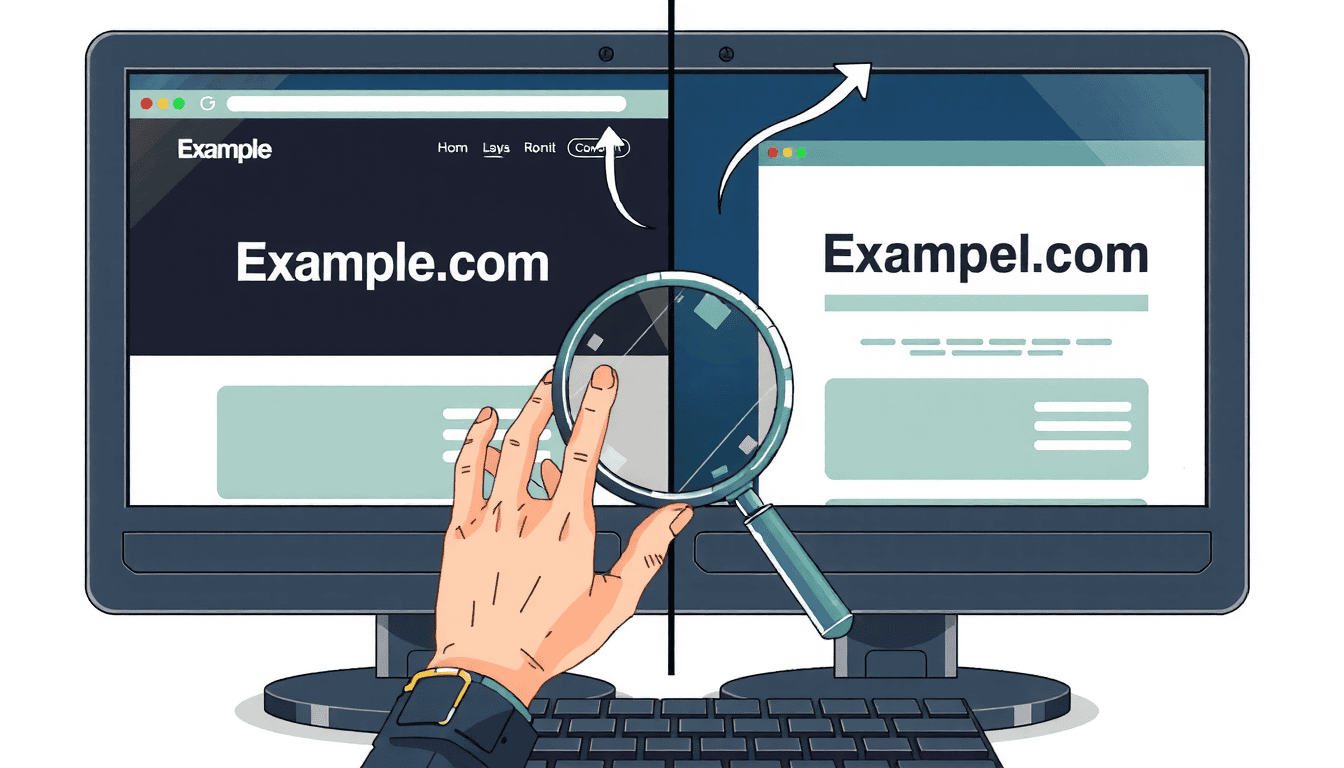
yourbrand-deals.comto trick your customers.Typosquatting: This threat targets users who make spelling mistakes. A typosquatter registers common misspellings of your domain. For example, if your site is
Example.com, they might registerExampel.com. They capture your traffic from simple typos.Brand-jacking: This is more harmful. A brand-jacker uses a similar domain to hurt your business. They might set up a phishing site to steal customer data or create a website to spread false, negative information about your brand.
Expiration Sniping: Your domain registration is not permanent. If you forget to renew it, it expires and becomes available to the public. "Snipers" use automated tools to register a valuable domain the second it becomes available. This can happen from a simple missed payment.
Homograph Attacks: This is a tricky and technical threat. Attackers use characters from different alphabets that look the same as Latin characters. For example, instead of using the letter 'a', they could employ a Cyrillic 'а'. To the naked eye, the domain looks correct, but it leads to a completely different, often harmful, website.
Building Your 3-Tier Domain Protection Strategy
A one-size-fits-all approach does not work. A more systematic way for your brand's domain name protection is a tiered strategy. This lets you scale your actions depending on your budget and the business stage you are at. A comprehensive domain strategy plays a pivotal role in establishing a strong online presence.
Here is a simple framework to follow.
| Tier | Actions | Best For |
|---|---|---|
| Tier 1: The Essentials | Secure your main .com and local country code (e.g., .co.uk). Turn on auto-renew, 2FA, and WHOIS privacy. |
Every business, from startups to solo workers. |
| Tier 2: Growth-Stage Defense | Register common misspellings and other key TLDs (e.g., .io, .app). Consider hyphenated versions. |
Expanding businesses with a growing customer base. |
| Tier 3: Enterprise-Level Fortification | Use a domain monitoring service. Add a Registry Lock to critical domains. Register negative domains (e.g., brand-sucks.com). |
Established brands with significant brand recognition. |
Tier 1: The Essentials
This is the common start for every business. First, secure your brand name with the .com extension. This is the most recognized top-level domain (TLD). Also, register the country-code TLD for your main market, like .de for Germany or .jp for Japan.
Right away, turn on auto-renewal for all domains. This prevents accidental expiration. Secure your registrar account with a strong, unique password and two-factor authentication (2FA). Finally, turn on WHOIS privacy. This hides your personal contact details from public view, reducing spam and risk.
Tier 2: Growth-Stage Defense
As your brand grows, so do the risks. Now it is time to expand your domain portfolio. Register the most obvious misspellings of your name. Think about how customers might mistype it.
Also, secure other key TLDs that are relevant to your industry, like .store for an e-commerce business or .app for a software company. If your brand name has two words, consider registering the hyphenated version (e.g., your-brand.com) and redirecting it to your main site.

Tier 3: Enterprise-Level Fortification
For well-known brands, defense must be more aggressive. Use a domain monitoring service. These services automatically scan for and alert you to new domain registrations that copy your trademark.
For your most critical domains, use a Registry Lock. This is an extra security layer that prevents any unauthorized transfers or changes at the registry level. It requires manual verification to make any updates. Some brands also defensively register domains with negative words, like yourbrandsucks.com, to prevent others from using them for criticism.
The "AuraBrew" Playbook: A Practical Walkthrough
Theory is good but practice is better. Let's visualize a scenario of protecting a brand's domain name through a real-world example. Let's think that we are launching a new sustainable coffee brand in 2026 called "AuraBrew."
Step 1: The Core Purchase (Tier 1)
The first thing we do is to secure the most important asset: aurabrew.com. We check availability and purchase it right away. Since we plan to launch in Canada right after, we also acquire aurabrew.ca. We go directly to our registrar's dashboard and enable auto-renewal and WHOIS privacy for both domains. This is our basic protection.
Step 2: Anticipating Confusion (Tier 2)
We know our brand name is unique but people might get confused or misspell it. To be safe we register aurabrewcoffee.com. This is clearer. We also think of common typos and register aruaabrew.com and aurabrew.com (a common typo).
Our promotion actions include an app that rewards customers. So we buy aurabrew.app beforehand. All these new domains are set to redirect to our main aurabrew.com site. This way, we catch all potential traffic.
Step 3: Long-Term Defense (Tier 3)

Six months since a successful launch and our brand is growing. We see a new competitor with a similar name. It's time to step up our protection for domain names. We invest in a domain monitoring service. This service sends us an email alert anytime a new domain containing "AuraBrew" is registered.
Because aurabrew.com is now a mission-critical asset driving all our sales, we contact our registrar to place a Registry Lock on it. This makes it nearly impossible for a hacker to steal our main domain.
Your Legal Shield: Trademarks and Dispute Resolution
Technical steps are crucial, but your strongest tool to protect your brand's domain name is the law. Registering your brand name as a trademark is the ultimate foundation of your defense. It gives you clear legal rights to your name.
When someone copies your trademark by registering a confusingly similar domain, you have powerful options. The two main paths for resolving disputes are the UDRP and the ACPA. Understanding them helps you take swift action. WIPO's Arbitration and Mediation Center reports handling a record number of cybersquatting cases in recent years, showing this is a growing problem for brands of all sizes.
Here is a simple comparison of your primary legal options:
| Factor | UDRP (Uniform Domain-Name Dispute-Resolution Policy) | ACPA (Anticybersquatting Consumer Protection Act) |
|---|---|---|
| Cost | Lower cost (a few thousand dollars) | Higher cost (can be tens of thousands) |
| Speed | Fast (typically 45-60 days) | Slower (can take many months or years) |
| Outcome | Domain transfer or cancellation | Domain transfer and potential monetary damages |
| Process | Arbitration (no court) | Federal lawsuit (in court) |
The UDRP is an administrative process designed to be faster and cheaper. It is ideal for clear-cut cases of cybersquatting where your main goal is to get the copying domain name back.
You can also seek remedies under laws such as the Anticybersquatting Consumer Protection Act (ACPA). This is a federal lawsuit in the United States. While more expensive and time-consuming, the ACPA not only allows you to recover the domain but also enables you to sue for financial damages caused by the cybersquatter.
Conclusion
Securing your brand's domain name in 2026 equals the creation of a digital fortress. It is an active, ongoing process, not a one-time task. By combining intelligent domain registration, strong security practices, and legal awareness, you configure layers of defense. A smart domain strategy is one of the best investments you can make in your brand's security and future success.
Frequently Asked Questions
1. How many domain variations should I actually buy?
Start with the "Tier 1" basics: your main .com and primary country code. Then, follow the 80/20 rule: secure the 20% of variations (like obvious misspellings and key TLDs such as .net or .org) that will prevent 80% of potential confusion. Avoid buying dozens of obscure TLDs unless you face a specific threat or have an enterprise-level budget.
2. Is WHOIS privacy protection worth the cost?
Yes, absolutely. For the majority of businesses, the small annual fee is a sound investment. It prevents your personal contact information, such as your name, address, and phone number, from being listed publicly. This simple step will substantially reduce spam and protect you from being directly targeted by bad actors.
3. What's the real difference between a domain name and a trademark?
A domain name is a web address that you rent from a registrar (e.g., mybrand.com). A trademark is a form of legal protection for your brand identity (like your name or logo) that you register with a government body. Owning a trademark gives you the legal power to stop others from using your brand name in their domain. Simply registering a domain does not give you trademark rights.
4. My ideal .com domain is taken but not in use. What should I do?
First, check if the name is trademarked. If not, you have a few options. You can consider a creative alternative, such as adding a verb (e.g., getmybrand.com) or using a different TLD like .io or .co. You can also use a domain broker service to try and negotiate a purchase from the owner. If you believe the owner is cybersquatting on your trademark, you can start a UDRP or ACPA action.
5. How much should I budget to protect my brand domain name?
Your budget can scale with your business. For basic "Tier 1" protection, expect to spend around $50-$100 per year for your primary domains and WHOIS privacy. For "Tier 2" protection with several variations, a budget of $200-$500 annually is a reasonable start. Enterprise-level protection with monitoring services can cost thousands, but this is not necessary for most small businesses.